
15 Years
Support areas
Reconciling Tensions
Shunbul Girls’ High School serves 190 children enrolled from 13 villages in Bamyan Province, Afghanistan. The primary economy, on which most families rely, is agriculture and livestock. Literacy rates are low, and many of the students’ parents, particularly mothers, did not complete their education.
Initial learning assessment showed students falling behind in many areas, including Literacy, Maths, Science, and Arts and Culture. Teachers identified high absenteeism as a critical problem, but why were children absent? To determine the root causes of student absenteeism, teachers interviewed the students as well as parents to hear their perspectives.
Students said they felt lessons lacked relevance and were too theoretical with a lot of teacher-led instruction. Students also highlighted the lack of support at home, something parents agreed and noted their lack of confidence to support their children’s learning.
Learning by doing
The teachers recognised that they needed to develop and deliver new teaching approaches that would be more relevant and interactive for learners.
Teachers undertook professional courses on participatory and child-centred pedagogy, supporting them to introduce new practices such as storytelling and roleplay to teach literacy/Dari; group work and problem-solving activities in Maths; while science became more hands on with experiments and outdoor learning.
Beyond this, teachers began to explore local traditions, historical sites, and artistic expression through their subject areas. Peer-to-peer coaching and mentoring helped to share ideas and support each other while parental engagement workshops focused on developing awareness on how to support their children’s learning at home.
test
These new pedagogical practices were tested with a class of 24 children over several months. End of year observations showed changes in teacher classroom practice and an increase in student attendance by 8%. The learner assessments demonstrated significant learning gains with 39% improvement in Dari, 72% in Mathematics, and 82% in Science.
After implementing this solution, we’ve witnessed remarkable changes in our school. Teaching methods have evolved completely, and the teachers have become much more creative. The motivation to bring positive changes to the school has increased significantly. Both teachers and students are now creating new educational approaches and models using participatory approaches and affordable or low-cost/no-cost materials.
Ready to bring this innovation to life?
This starter kit has everything you need to get started with helpful tips, and all the inspiration to help you make it your own.
Integer eu condimentum ante. Pellentesque vitae ultricies mauris. Praesent facilisis quis est eget facilisis. Integer malesuada laoreet ultricies. Sed hendrerit imperdiet metus vel rhoncus. Nulla eleifend massa ut mauris fringilla, at ultrices.
testt
Video title can go here
Aliquam elit libero, volutpat sed eros vel, pulvinar fringilla arcu. Aenean fermentum rhoncus sem, id scelerisque ipsum varius a. Vestibulum ante ipsum primis in faucibus orci luctus et ultrices posuere cubilia curae; Etiam in imperdiet quam, eu aliquam leo. Praesent ut dui tempus, auctor orci quis, euismod quam.
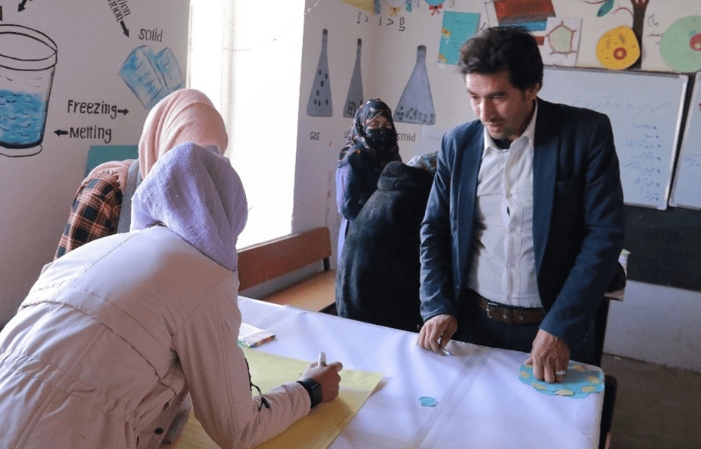
Learning by doing – The journey of teacher Ghulam Abas Haidari
Morbi non ex pulvinar, facilisis arcu rutrum, aliquet purus. Donec dapibus maximus congue. Integer fermentum justo porttitor, vulputate velit vitae, porta est.
Sed rutrum magna vel hendrerit cursus. Nullam sed consectetur nisi, non mollis dui. Fusce ut dolor et nisi consequat sodales. Quisque vel consequat dolor.
Sed rutrum magna vel hendrerit cursus. Nullam sed consectetur nisi, non mollis dui. Fusce ut dolor et nisi consequat sodales. Quisque vel consequat dolor.
More Innovations
No settings found for the grid #16.